Reading a paper about using roots to measure forest fire carbon releases:
www.lter.uaf.edu/pdf/1476_Boby_Schuur_2010.pdf
The paper mentions forest fires that burn under a tree burn 6.4% less deep into soil organic layer than where there is no tree. There is more carbon in deeper layers. Still, at 10kg of carbon/m^2, only including stores in the first foot or so, this suggests a few cms of moss or litter is enough to keep sequestered maybe 300g/m^2 of carbon in a forest fire. Under the trees is less litter and where there are no trees is 3cm of litter. If the paper is right, a few cms of litter or moss that contain only dozens of grams of carbon/m^2 would preserve perhaps 10x as much carbon in the soil beneath, during a forest fire. The paper only mentions a fraction of 3cm difference sequestering 6.4% of soil carbon depth, but even more litter/moss ougth to yield even greater soil carbon sequestration if/when a forest fire happens.
Sphagnum fuscum will take 3-30 years to become 3cm of "brown moss", depedning on BM definition. A faster growing plant would yield the protective behaviour quickly. Brachythecium (a moss) grows 6 vertical inches/yr. Cat-tails spread up to 17 horizontal inches/yr. If either of these when decomposed to peat and survivors removed as weeds, form a useful peat substrate for Sphagnum fuscum, such labour intensive land management would be cost-effective in a carbon-priced world over a large area.
Showing posts with label AGW mitigation. Show all posts
Showing posts with label AGW mitigation. Show all posts
Monday
research pitfalls and optimal Acrotelm transplant size
Several researchers have done brilliant work unfortunately on Sphagnum species that aren't fuscum; that release CO2 upon decay. Other Sphagnum species might be useful to fuscum. If they are acidic, competing vegetation is killed off; minerotrophic fen becomes an ombotrophic bog. They may moderate the water table to fuscum optimal. For instance, the only Sphagnum species that will grow over a pond is S.Riparian. S.Riparian should speed up the time it takes for a pond shore to be a suitable S.fuscum afforestation site. Thirsty coniferous trees may help too in adding soil acidity. S.fuscum is in direct competition in some areas with grasses and decidious trees. The competition aerates the soil, draining it. Cottongrass gives shelter and moisture to S.fuscum clippings and spores.
For a few years, tiny S.fuscum prefers a higher water table to what mature peat moss is optimized for. Mature S.fuscum prefers a lower water table as it competes better using superior water storage morphology to other species.
Plant species may also be useful for afforesting S.fuscum in that peat accumulates faster than 1mm/yr for some other parent species. If this peat is useful to S.fuscum transplanted Acrotelm, the quickest cheapest way of succeeding rock may be to 1st seed a fast growing fen seed mix and years later introducing S.fuscum. There is a need for more snow/rain gauges up north.
Researchers often publish the NPP of their Sphagnum fuscum research. This is carbon sequestered without mentioning carbon released. The net is NEP. NPP is useless.
Smaller Acrotelm sizes need more moisture; two optimal transplant sizes/methodologies will emerge. Larger chunks survive winter better. Here transport costs rule. Afforestation would take place near existing bogs and the procedure would be much like existing transplant research:
http://www.gret-perg.ulaval.ca/uploads/tx_centrerecherche/Cagampan_etal_HydrolProc2008.pdf
...except the new peat bogs to be grown would be an array of site types beyond past vacuum harvested bogs. Clippings and spores (research in infancy) are other potential afforesting materials. These may be sustainably harvested from existing bogs, or farmed/greenhoused. Small transport costs but decreased survivability of transplants. Probably spores or clippings would survive on prospering transplanted larger chunks.
The carbon value of peat moss isn't great. Historically NEP in N.Alberta or S.NWT was as high as 70 grams C/m^2/yr, where it is now maybe 3g/C/m^2/yr. Research suggests 10g/C/m^2/yr is average. 28g/C/m^2/yr is TKG target assuming optimized water table. S.fuscum only grows horizontally at 1.5cm/yr. If strips are harvested sustainably out of existing bogs and are to recover sustainably in 10 yrs, 30cm strips would be optimal width. Because Acrotelm 10cm deep is viable, a rototiller that can shave off thin top layers a few cms thick would be a great invention. Any improvement over a pitchfork is good.
For a few years, tiny S.fuscum prefers a higher water table to what mature peat moss is optimized for. Mature S.fuscum prefers a lower water table as it competes better using superior water storage morphology to other species.
Plant species may also be useful for afforesting S.fuscum in that peat accumulates faster than 1mm/yr for some other parent species. If this peat is useful to S.fuscum transplanted Acrotelm, the quickest cheapest way of succeeding rock may be to 1st seed a fast growing fen seed mix and years later introducing S.fuscum. There is a need for more snow/rain gauges up north.
Researchers often publish the NPP of their Sphagnum fuscum research. This is carbon sequestered without mentioning carbon released. The net is NEP. NPP is useless.
Smaller Acrotelm sizes need more moisture; two optimal transplant sizes/methodologies will emerge. Larger chunks survive winter better. Here transport costs rule. Afforestation would take place near existing bogs and the procedure would be much like existing transplant research:
http://www.gret-perg.ulaval.ca/uploads/tx_centrerecherche/Cagampan_etal_HydrolProc2008.pdf
...except the new peat bogs to be grown would be an array of site types beyond past vacuum harvested bogs. Clippings and spores (research in infancy) are other potential afforesting materials. These may be sustainably harvested from existing bogs, or farmed/greenhoused. Small transport costs but decreased survivability of transplants. Probably spores or clippings would survive on prospering transplanted larger chunks.
The carbon value of peat moss isn't great. Historically NEP in N.Alberta or S.NWT was as high as 70 grams C/m^2/yr, where it is now maybe 3g/C/m^2/yr. Research suggests 10g/C/m^2/yr is average. 28g/C/m^2/yr is TKG target assuming optimized water table. S.fuscum only grows horizontally at 1.5cm/yr. If strips are harvested sustainably out of existing bogs and are to recover sustainably in 10 yrs, 30cm strips would be optimal width. Because Acrotelm 10cm deep is viable, a rototiller that can shave off thin top layers a few cms thick would be a great invention. Any improvement over a pitchfork is good.


Sunday
transplanted Acrotelm open question
Centuries old Sphagnum fuscum has amazing moisture regulatory mechanisms. S.fuscum transports moisture by wicking it up hollow microtubules. A question is to what degree this is impaired by removing the 10cm top layer (the top 10cm exhibit successful vegetative regrowth) and transplanting it upon another substrate? University of Quebec research has transplanted Acrotelm to a dessicated peat layer that was vacuum harvested years before. The diurnal cycle of moisture movement was somewhat impaired. This was attributed to "voids"; a topological configurational mismatch between the bottom of the Acrotelm and the top of the dried peat: http://www.gret-perg.ulaval.ca/uploads/tx_centrerecherche/Cagampan_etal_HydrolProc2008.pdf
A different and fine-grained explanation is S.fuscum water droplet transporting microtubules remain mostly intact and functional after years of decay and a little functional after decades or more of decay. Severing nerves would be the rough analogy to removing the Acrotelm. It is important to know whether moisture transport can be maintained efficiently with Acrotelm transplanted to a new substrate. If it can't be, transplanted substrates will have to be much thicker and the most efficient geometry may be World Trade Centres rather than a roll of sod or a cube. The above referenced research took place in a bog with 1200mm/yr precipitation, and the transplanted Acrotelm survived and grew on the vacuumed peat. The cheapie real estate is 600mm/yr of that or less...
The cheapie real estate is now boreal forests, rock, tundra, glaciers, shallow freshwater. For reference, S.fuscum grows horizontally 1.5cm/yr and vertically at 1-2cm/yr, before compression to 1mm/yr after about 30 years.
Hydraulic Conductivity material property estimate aren't of much use. Sand and acrotelm have apporximately the same hydraulic conductivity: 10^-4 m/s. Acrotelm can wick water from below more efficiently. It would be nice to have better near surface geological surveys to open up the field. S.fuscum minimizes the incidence and number of forest fires, and where dryer tundra is at fire risk, the S.fuscum carbon economics are very favourable. Over centuries S.fuscum builds up its own perched water table. The permafrost will be melted entirely in 100 years; needs our help if existing Arctic carbon is to remain sequestered.
A different and fine-grained explanation is S.fuscum water droplet transporting microtubules remain mostly intact and functional after years of decay and a little functional after decades or more of decay. Severing nerves would be the rough analogy to removing the Acrotelm. It is important to know whether moisture transport can be maintained efficiently with Acrotelm transplanted to a new substrate. If it can't be, transplanted substrates will have to be much thicker and the most efficient geometry may be World Trade Centres rather than a roll of sod or a cube. The above referenced research took place in a bog with 1200mm/yr precipitation, and the transplanted Acrotelm survived and grew on the vacuumed peat. The cheapie real estate is 600mm/yr of that or less...
The cheapie real estate is now boreal forests, rock, tundra, glaciers, shallow freshwater. For reference, S.fuscum grows horizontally 1.5cm/yr and vertically at 1-2cm/yr, before compression to 1mm/yr after about 30 years.
Hydraulic Conductivity material property estimate aren't of much use. Sand and acrotelm have apporximately the same hydraulic conductivity: 10^-4 m/s. Acrotelm can wick water from below more efficiently. It would be nice to have better near surface geological surveys to open up the field. S.fuscum minimizes the incidence and number of forest fires, and where dryer tundra is at fire risk, the S.fuscum carbon economics are very favourable. Over centuries S.fuscum builds up its own perched water table. The permafrost will be melted entirely in 100 years; needs our help if existing Arctic carbon is to remain sequestered.
sphagnum fuscum is an emergent field

The top "living" layer of peat moss grows seamlessly on the "dead" peat. The top layer is called Acrotelm; is 10cm deep. It accumulates at around 1cm/yr and is subsequently compressed as it accumulates in the lower catotelm/peat layer at a rate of 1mm/yr. 15m deep peat is the S.fuscum limit. Other types of peat likely emit methane; other plant species should be researched here only as a succession target or as S.fuscum symbiotes and temporary pioneer species.
Acrotelm has been reintroduced upon dry harvested peatland with moderate success. There were noticable gaps caused by hysterisis. If this is the only issue, rolling reclaimed peatland might help at a cost.
No one has yet tried to introduce acrotelm from an intact S.fuscum peatland, and introduced it where no S.fuscum peatland exists. 1/3 of the existing Acrotelm can be safely harvested with regrowth in a few years in peat lands where rainfall is 1200mm/yr. Possible moisture holding substrates for reintroducing Acrotelm (chunks of 4000cm^3 will survive/grow better than 2000cm^3) upon include stand-alone or a combination of:
- Peat deposited by faster growing and decaying plant species.
- Loess or silt. Silt covering Acrotelm is not desired.
- Clay or clayey soil.
- Thin slivers of S.fuscum peat at potentially different stages of "decay", separated from a metres deep peat "deposit".
Saturday
why wheat
Food stores are useful to have for a variety of shocks and emergencies. Rice exhibits survival over a large temperature range. Oats are edible raw. Soy contains all essential Amino Acids. Other crops probably grow on marginal land. But it is wheat that is most storable under appropriate conditions: cool, dry, protected from insects, vermin, fungi, etc. Edible wheat has been recovered from the pyramids thousands of years old. Wheat presently costs 2% of crop cost, to store in modern silos. Mostly this is the cost of drying and refrigeration.
There are potential ways of decreasing this cost: Novel polymer bags, new silos and storage bins, GMO varieties, the presence of permafrost suggests refrigeration costs can be lowered. Other food crops might be engineered one day to bequeath the storability of wheat. Most of the oil in wheat is in the wheat germ, which is not stored in silos.

Spelt wheat. An uncommon variety, by virtue of its hard covering Spelt is particularly resilient.
There are potential ways of decreasing this cost: Novel polymer bags, new silos and storage bins, GMO varieties, the presence of permafrost suggests refrigeration costs can be lowered. Other food crops might be engineered one day to bequeath the storability of wheat. Most of the oil in wheat is in the wheat germ, which is not stored in silos.

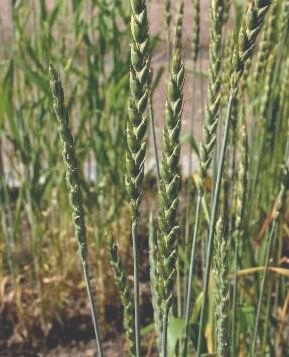
Spelt wheat. An uncommon variety, by virtue of its hard covering Spelt is particularly resilient.
Subscribe to:
Posts (Atom)